2026-01-12 19:28:19
| 3. Physical Design (Pipes, Spherical Packets, Storage and
Drop-Off Model) The primary physical component is a pipe (approximately 15 cm in diameter) that connects between
utility poles. Inside the pipe, a roughly 10 cm class metal sphere (the spherical packet) travels as the
'packet'. Assuming electromagnetic transport, the pipe houses coils, internal cameras,
communication cables, power cables, edge AI terminals, and sensors.
One structural option is a double-pipe design: an outer pipe of about 15 cm diameter contains a
central inner pipe of about 10 cm diameter (the transport channel). The remaining annular space
(roughly 2.5 cm per side) is used for coils and other equipment. Exact dimensions are left to detailed
engineering; this document presents the basic concept. 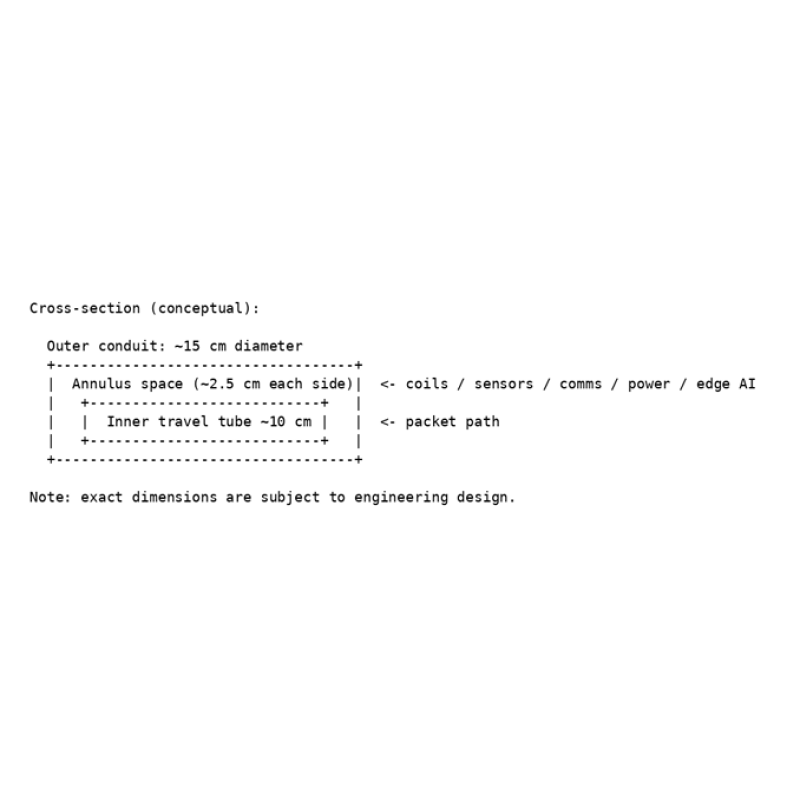
Figure 3. Double-pipe cross-section (ASCII). The inner pipe (about 10 cm) is centered within the outer pipe (about 15 cm); the surrounding space hosts coils, sensors, communications, power, and edge AI. A home unit receives the spherical packet and opens it at a designated position so that the contents
drop into the mailbox area. While this model simplifies mechanisms, it cannot handle fragile items
that cannot tolerate rolling, acceleration/deceleration, or drop impact. As a staged rollout, it is
acceptable to start with receive-only home units for safety and cost reasons. 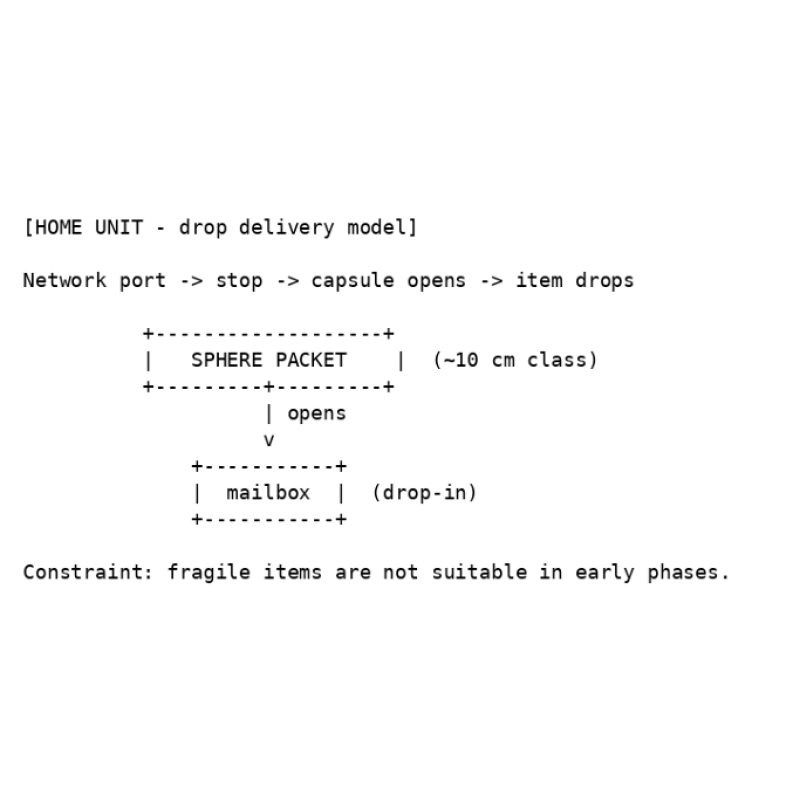
Figure 4. Home-unit drop-off model (ASCII). Fragile items are excluded in the initial specification. As a future extension, the system could also transport liquids. For example, households could
connect a tank unit; in regions where water is scarce, the network may carry only water in leak-proof
packets. Because liquid mode requires quarantine, hygiene, and pressure management, it is
positioned as a later expansion. 3.1 Packet Send/Receive Terminal (Inner Sphere + Outer Shell
Sphere) At each household or facility, the send/receive terminal accepts a user-provided foam spherical
container (the inner sphere). When the user requests delivery via the app, a reusable metal sphere
(the outer shell) arrives from the IMS. Inside the terminal, the outer shell encloses the inner sphere
and the combined packet departs immediately. At the destination, the process is reversed: the outer
shell is separated and recovered; only the inner sphere (the item side) is handed to the recipient.
Outer shells circulate within the system and do not accumulate outside it. • Place the inner sphere (foam container) into the terminal. • Request delivery via the app. • An outer-shell sphere (metal) arrives from IMS, encloses the inner sphere, and departs. • At arrival, the outer shell is recovered and re-injected; only the inner sphere is handed over. 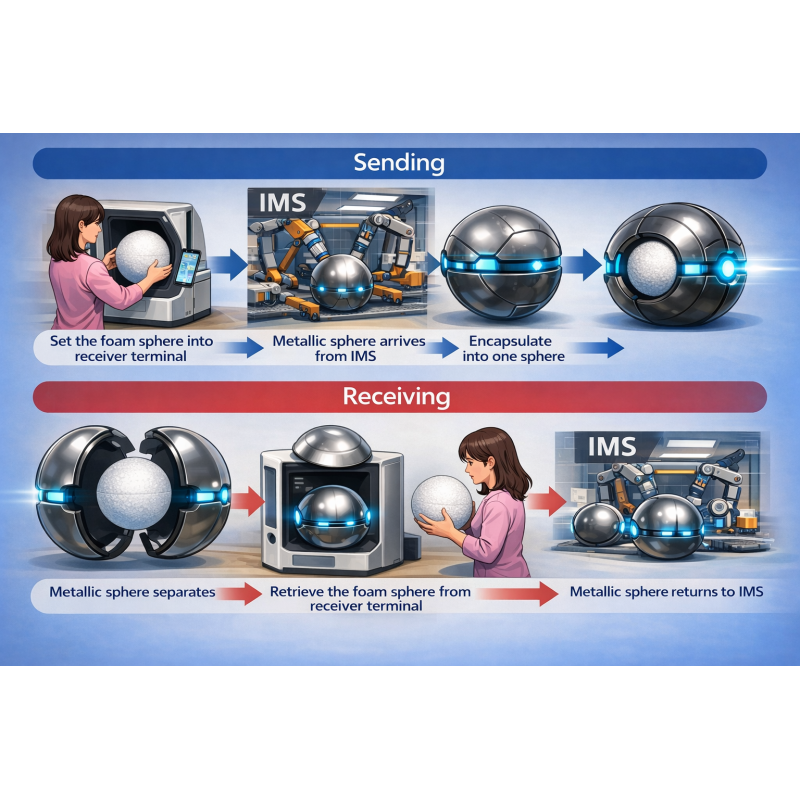
Concept illustration for the terminal and the inner-sphere/outer-shell mechanism (image includes conceptual labels). 3.2 Water Delivery Terminal (Dedicated Outer Shell + Direct Tank
Connection) For water delivery, the system uses dedicated metal spheres (outer shells) reserved for water. The
source-side terminal is connected to a reservoir, and the metal sphere is filled directly inside the
reservoir. The destination terminal is connected directly to a household or facility tank. After arrival,
water is injected from the sphere into the tank and the sphere is recovered and re-injected into the
system. The app continuously monitors tank level and can automatically request replenishment when
it drops below a threshold. • Source terminal: connected to a reservoir; spheres are filled directly in the reservoir. • App: monitors tank level and requests replenishment as needed. • Destination terminal: directly connected to a tank; injects water upon arrival. • Metal spheres: recovered after injection and circulate within the system.
|
 physical internet